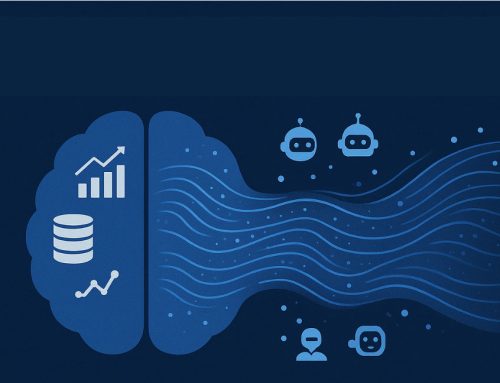

From Reporting to Reasoning – How AI Is Transforming Dashboards from Passive Displays to Active Decision Engines
For most of the last two decades, the business intelligence stack has operated on a fundamental assumption: that decision-makers know what questions to ask before they open a dashboard.
They navigate to the right report, apply the right filters, and interpret a snapshot of data that was current as of the last refresh cycle.
The process works… until the pace of operations outstrips the pace of reporting, and the gap between “data available” and “decision made” starts costing real money.
AI-powered analytics collapses that gap. And the organizations moving fastest right now are the ones that have stopped thinking of analytics as a reporting function and started treating it as a decision infrastructure.
The Shift From Descriptive to Anticipatory
Traditional BI answers one question well: what happened? Revenue by region, conversion by channel, tickets by category: the classic backward-looking view that tells you where you’ve been. The architecture underneath it (dimensional models, scheduled ETL, pre-built report trees) was designed around that question.
The question business leaders are actually asking in 2025 is different: what will happen next, and what should I do about it?
That requires a fundamentally different analytical posture.
Descriptive analytics tells you a trend line has been declining for three quarters. Predictive analytics tells you it will decline for two more before stabilizing, given current pipeline health. Prescriptive analytics tells you which intervention (pricing adjustment, resource reallocation, customer success outreach) has the highest probability of changing that trajectory.
Modern AI-powered analytics platforms integrate all three layers.
Machine learning models run continuously against live data streams, updating probability estimates as new signals arrive. The output surfaces inside the interfaces decision-makers already use, rather than requiring a separate trip to a data science team with a two-week turnaround.
Conversational BI and the End of Dashboard Hunting
One of the more underappreciated productivity drains in large organizations is the time executives and business unit leaders spend navigating BI environments: drilling through dashboards, reformatting exports, waiting on analysts to answer one-off questions.
Natural language querying, now embedded in platforms like Microsoft Fabric, Tableau Pulse, ThoughtSpot, and Looker’s conversational layer, eliminates most of that friction.
A head of sales operations can type “show me accounts over $500K ARR that haven’t had an activity log in 45 days, ranked by renewal date” and get a live, filterable answer in seconds… without writing SQL, without opening a ticket, and without the cognitive overhead of remembering which report contains that data.
The same capability scales across finance, supply chain, and marketing functions, each with domain-specific semantic layers that ensure the model interprets “margin” or “conversion” consistently with how that team defines it.
This is not a cosmetic upgrade to the BI interface. It fundamentally changes who can participate in data-driven decision-making and how quickly insights translate into action.
Detecting the Signals That Static BI Misses
Perhaps the most strategically significant capability in AI-powered analytics is anomaly detection and micro-signal identification: the ability to surface patterns that would never appear on a standard dashboard because no one thought to build a chart for them.
Consider customer sentiment. A static BI environment might track NPS scores on a quarterly survey cadence. An AI-powered analytics layer processing support ticket text, call transcripts, and in-app behavior can detect early sentiment softening (a specific cluster of phrases, an uptick in a particular error code correlated with churn) weeks before it registers on any survey.
The same logic applies to equipment performance in manufacturing environments, where subtle degradation patterns in sensor data precede failures by days or weeks, and to fraud detection in financial services, where the meaningful signal is often a combination of individually unremarkable data points.
The strategic value here is intervention timing. Catching a problem when it’s a whisper is categorically different from catching it when it’s a fire alarm.
Embedding AI Analytics Into the Moment of Decision
The architecture question that separates effective AI analytics deployments from expensive experiments is integration depth.
AI-powered analytics delivers its full value when insights surface inside the workflows where decisions actually get made (inside CRM records, inside ERP exception queues, inside the collaboration tools where teams are already operating) rather than in a separate analytics portal that requires a deliberate context switch to consult.
Achieving that level of integration requires more than licensing a platform. It requires mapping decision workflows, identifying where latency currently exists between data and action, designing the right semantic layer for each business domain, and building the data pipeline infrastructure that keeps models running against current data rather than yesterday’s warehouse snapshot.
At ASB Resources, that implementation depth is precisely where our engagements are focused. We architect AI-powered analytics environments that are built around your specific decision workflows — so your teams stop hunting for insights and start having them delivered at the moment they’re actually useful.
The dashboard was always a means to an end. The end was better decisions, faster. AI gets you there.
Is your organization still relying on weekly reports and static dashboards to drive decisions that need answers today?
Let the experts at ASB Resources design and deploy an AI-powered analytics environment that puts the right insights in front of your decision-makers at exactly the right moment. Schedule a call with one of our experts today!
 The "Weekend Modernization" – How IBM Bob Transforms Complex Migrations from Months to Days
 Beyond Code – How IBM Bob Is Redefining Governance in Regulated Software Development